
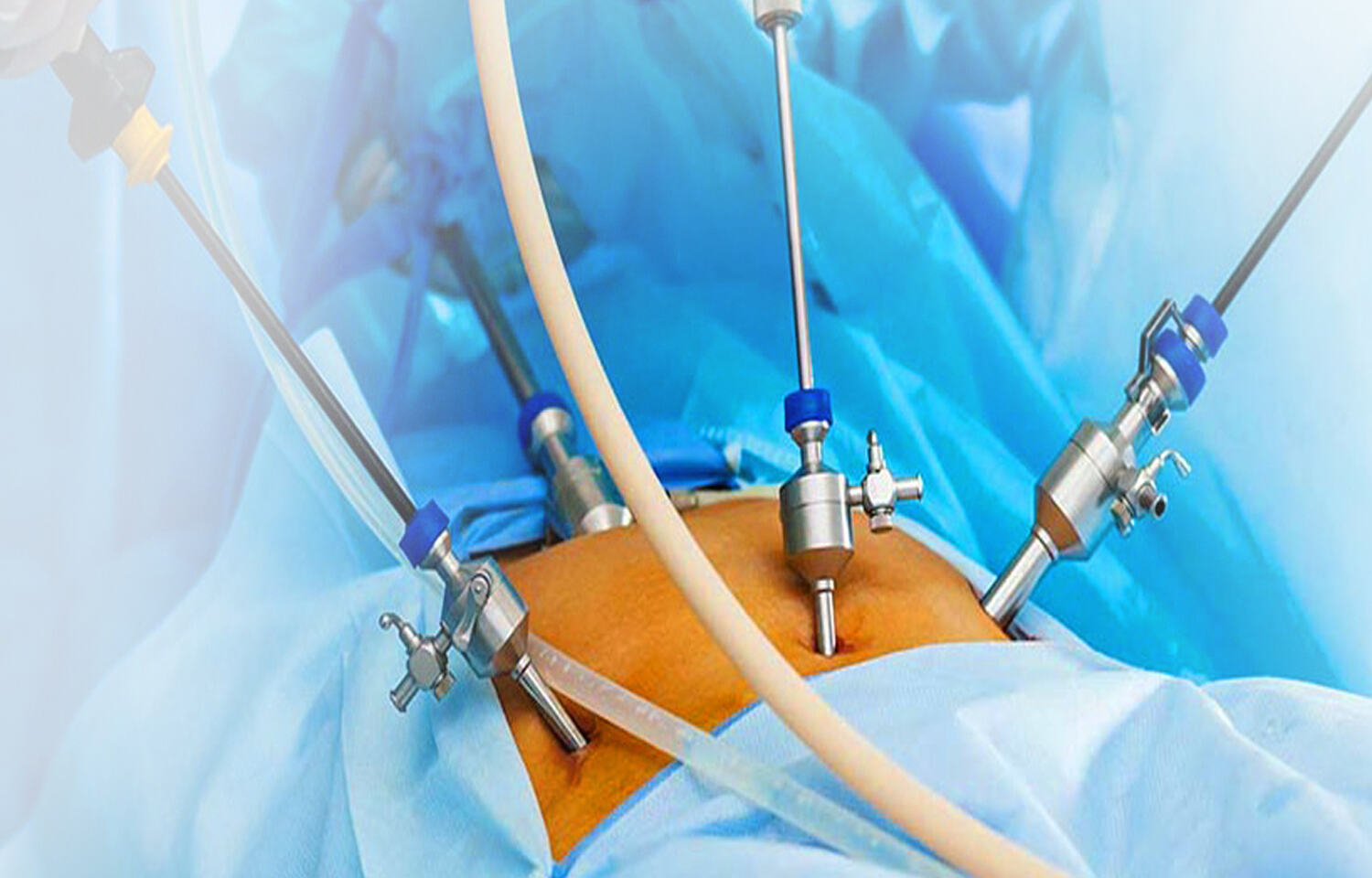
As we saw in another article, one of the surgical management options for bowel endometriosis is the laparoscopic segmental bowel resection (removal of the affected segment of the bowel). But how is the actual specimen removed?
Classically, a small incision below the belly button is required to remove the specimen. Although this incision is smaller than that of a caesarean section, the aesthetic result would be better if we could spare the above-mentioned incision.
This can be achieved through the use of Natural Orifice Specimen Extraction (NOSE)1. The first such procedure for sigmoid colon endometriosis was described by Redwine and Sharpe in 19912. In the recent years, there has been an increasing interest in the use of this surgical approach3-7.
There are 2 natural orifices that can be used: the vagina and the anus: 1. Through the vagina (Trans-vaginal): This is the preferred approach in case of concomitant hysterectomy. 2. Through the anus (Trans-anal): in the rest of cases, the specimen is removed through the anus.
In conclusion, the use of natural orifices (vagina or anus) has aesthetic benefits as it allows to spare the additional horizontal incision bellow the belly button. Concerns regarding the increased risk of infection do not appear to be confirmed by recently published data7.
References:
- Grigoriadis G, Merlot B, Dennis T, Roman H, Natural Orifice Specimen Extraction Colectomy for Endometriosis: How We Do It, SEUD Congress, Athens, May 2022 (Video Presentation).
- Redwine DB, Sharpe DR. Laparoscopic segmental resection of the sigmoid colon for endometriosis. J Laparoendosc Surg. 1991 Aug;1(4):217-20.
- Wolthuis AM, Fieuws S, Van Den Bosch A, de Buck van Overstraeten A, D’Hoore A. Randomized clinical trial of laparoscopic colectomy with or without natural-orifice specimen extraction. Br J Surg. 2015 May;102(6):630-7. doi: 10.1002/bjs.9757. Epub 2015 Mar 12. PMID: 25764376.
- Akladios C, Faller E, Afors K, Puga M, Albornoz J, Redondo C, Leroy J, Wattiez A. Totally laparoscopic intracorporeal anastomosis with natural orifice specimen extraction (NOSE) techniques, particularly suitable for bowel endometriosis. J Minim Invasive Gynecol. 2014 Nov-Dec;21(6):1095-102. doi: 10.1016/j.jmig.2014.05.003. Epub 2014 May 22. PMID: 24858985
- Malzoni M, Rasile M, Coppola M, Iuzzolino D, Casarella L, Di Giovanni A, Falcone F. Totally Laparoscopic Resection with Transanal Natural Orifice Specimen Extraction for Deep Endometriosis Infiltrating the Rectum. J Minim Invasive Gynecol. 2021 Jul 30:S1553-4650(21)00355-1. doi: 10.1016/j.jmig.2021.07.015. Epub ahead of print. PMID: 34333148
- Ghezzi F, Cromi A, Ciravolo G, Rampinelli F, Braga M, Boni L. A new laparoscopic-transvaginal technique for rectosigmoid resection in patients with endometriosis. Fertil Steril. 2008 Nov;90(5):1964-8. doi: 10.1016/j.fertnstert.2007.09.002. Epub 2007 Dec 27. PMID: 18163992.
- Grigoriadis G, Dennis T, Merlot B, Forestier D, Noailles M, François MO, Hajdinák A, Roman H. Natural Orifice Specimen Extraction (NOSE) colorectal resection for deep endometriosis: A 50 case series: NOSE resection for DIE: 50 cases. J Minim Invasive Gynecol. 2022 May 17:S1553-4650(22)00202-3.